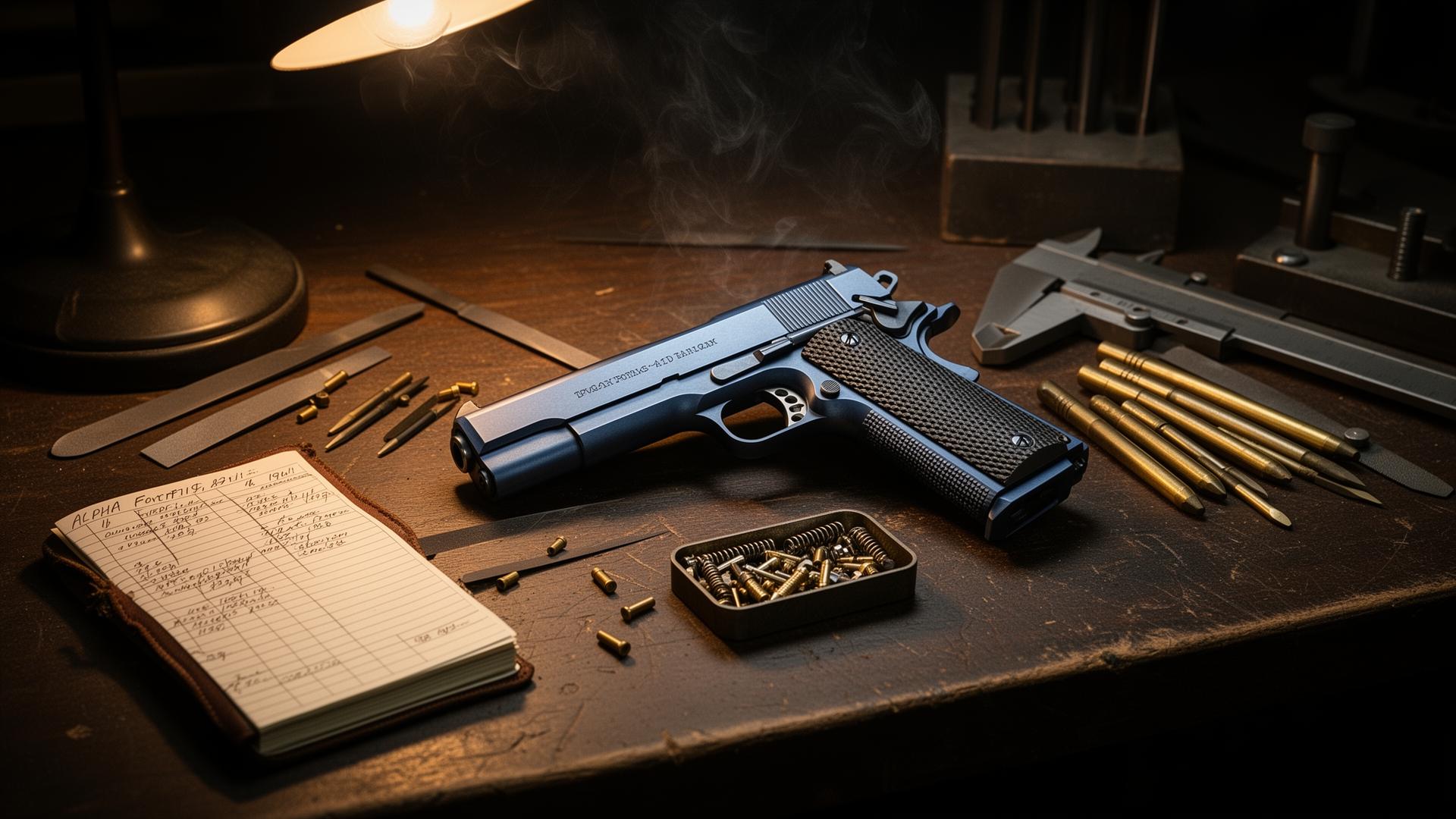
Ask a custom 1911 gunsmith which pistol to carry and you will rarely get a single answer. The question is older than most of the shooters who ask it — first solved by John Browning in 1911, and re-solved a century later by the men who took his single-stack and gave it a wider grip, a double-column magazine, and a name two digits forward. The 1911 and the 2011 are not rivals. They are father and son, and the choice between them is less about caliber than about character.
I. What the 1911 keeps
The custom 1911 is the unbroken line. A single-stack frame, typically in .45 ACP, with a grip thin enough that a small hand can wrap it and a trigger pull that — when cut by a careful gunsmith — breaks like glass at four pounds. It is the pistol the U.S. military carried for seventy-four years, the pistol that built the bullseye discipline, and the pistol that taught two generations of shooters what a clean trigger feels like.
A founder-grade custom 1911 is a object of restraint: hand-fit slide-to-frame, hand-cut checkering on a flat mainspring housing, a tritium front sight quietly let into a serrated rear. Seven rounds in the magazine, one in the chamber. The weight of it in the hand is part of the contract.
II. What the 2011 adds
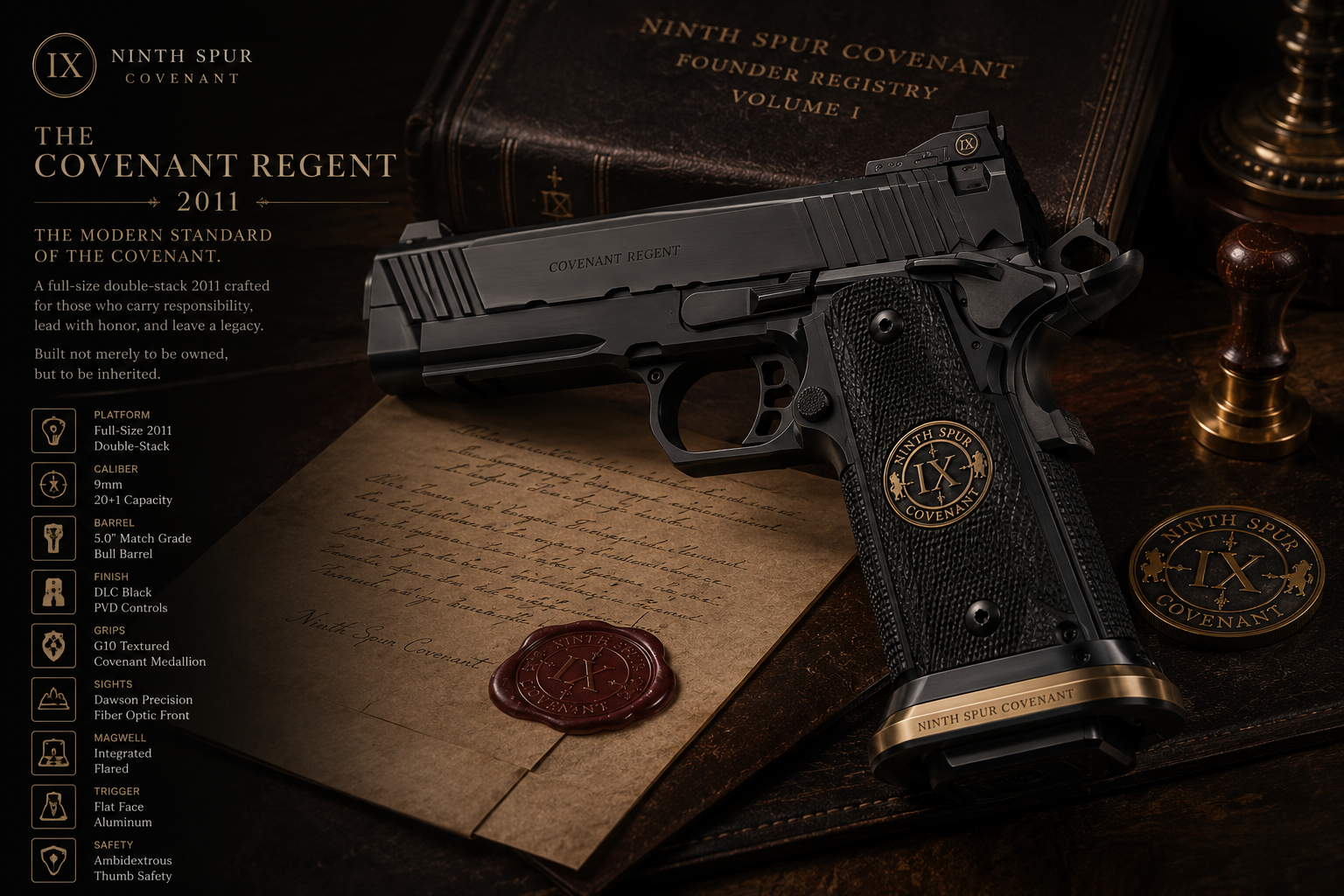
The 2011 was a modular answer to a modern question: what if you kept the 1911 trigger and added capacity? Strayer-Tripp built the first ones for IPSC competition in the early 1990s. The frame became two pieces — a steel top half and a polymer grip module wide enough for a 17- to 20-round double-stack magazine, usually in 9mm.
In the hand a 2011 feels like a 1911 that has been to the gym. The slide rides the same rails, the same beavertail meets the same web of the thumb, the same single-action trigger breaks cleanly — but the grip is wider, the round count is doubled, and the recoil impulse of 9mm is, by every measure, easier on the shooter across a long string.
III. The honest tradeoffs
- Capacity. 8 rounds of .45 versus 18 to 21 rounds of 9mm. The 2011 wins this on the paper.
- Concealment. The 1911's narrow grip disappears under a shirt. A 2011 grip module, even a thinned one, prints. The 1911 wins this under a jacket.
- Trigger. Both are short-reset single-actions and both, properly tuned, are among the best triggers a defensive pistol can carry. Call this even.
- Recoil. 9mm out of a 2.4 lb steel-and-poly 2011 is gentle. .45 out of a 2.4 lb all-steel 1911 is firm but slow. The 2011 wins on speed; the 1911 wins on the felt sense that you fired a serious round.
- Cost of a good one. A production 1911 starts around $1,200. A custom 1911 from a careful bench starts at three times that. A custom 2011 from a top maker — Atlas, Cheely, Staccato XC — runs between four and seven thousand dollars. Neither pistol is cheap, and neither should be.
- Maintenance. A 1911 is eight major parts you can clean blindfolded. A 2011, with its double-stack magazine geometry and grip-module interface, is less forgiving of neglect. Carry what you will actually clean.
IV. How a gunsmith chooses
The 1911 is the pistol you keep for forty years and pass to a grandchild. The 2011 is the pistol you compete with on Sunday and carry the rest of the week if you can dress around the grip. Both deserve a careful gunsmith's hand. Both reward a shooter who practices.
At our bench we still build single-stack 1911s as the foundation of the gunroom — a founder-grade .45, hand-fit, blued, and signed in the ledger. We build double-stack 2011s when the asking is for capacity, for competition, or for a working sidearm carried at length. The question to ask first is not which is better. It is which one you will actually carry, train with, and keep.
Keep the steel. Keep the name. Keep the hour.
See the founder-grade custom 1911 and the working 2011s currently on the bench.
Enter the Showcase →